Every Web3 Hack Is a Security Lesson. Is Your Protocol Paying Attention?
Every week, Web3 protocols lose millions to vulnerabilities, compromised credentials, and security failures. Many of these attacks exploit weaknesses that have been known for years.
The real question isn’t just how these protocols were hacked, but whether the same attack vectors could affect yours.
That’s why CD Security created Web3 Exploit Intelligence.
Twice a month, we analyze real-world Web3 hacks, identify the attack vectors behind them, and provide practical security recommendations for protocols that could face similar risks.
Our goal is simple: turn real-world exploits into actionable security insights that help teams identify potential weaknesses before attackers do.
Explore the statistics, find your protocol category, and see which attack patterns deserve your attention.
Statistics
20 incidents | $50,073,473 in reported snapshot losses | 6 with undisclosed financial amounts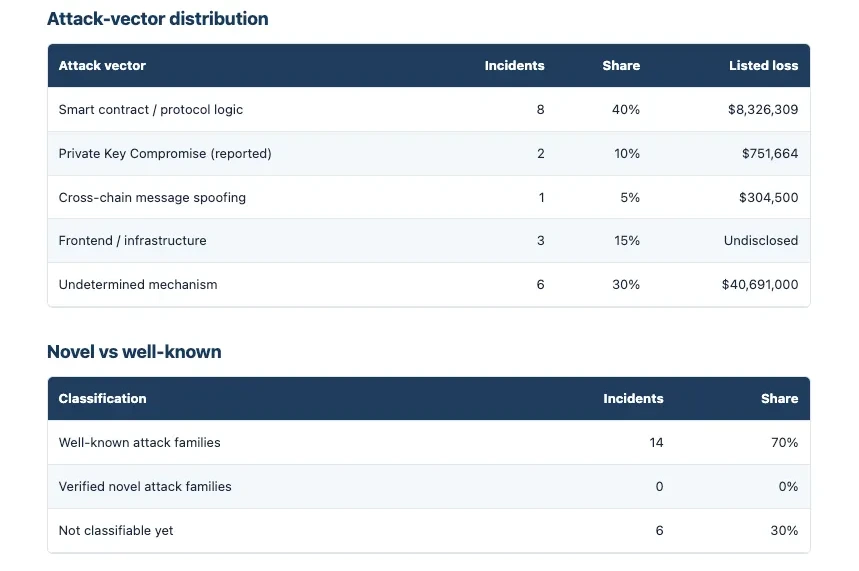 The existing attack family of an incident can be identified even if its exact entry path or vulnerable line has not been proven. No specific attack is claimed to be the first of its kind.
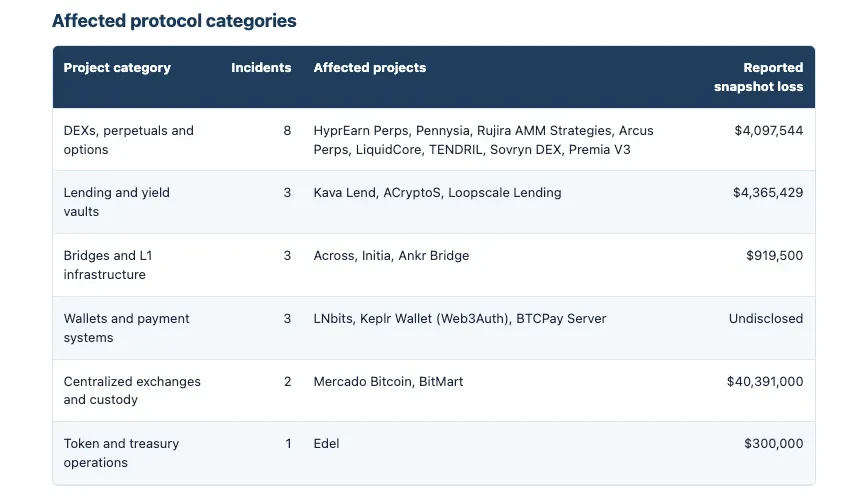
All 20 projects are named in this statistical table. Incidents without sufficient evidence to identify a specific attack mechanism are counted here but are not discussed individually below.
A. NOVEL ATTACK VECTORS
No verified novel attack family identified in this reporting period
B. WELL-KNOWN ATTACK VECTORS EXPLOITED AGAIN
These are attack patterns already documented in historical research. Each implementation and entry path may still be different.
1. Kava Lend - $3,700,000 - Lending and yield vaults
An attacker targeted a nearly empty BUSD lending market and reduced the effective supply to a tiny nonzero value. The resulting interest-index calculation reportedly inflated collateral claims by about 243,000 times, enabling repeated KAVA borrowing. The affected lending stack uses Go-based Cosmos SDK modules. Kava reported that the incident was confined to Kava Lend, while a complete official technical post-mortem was not available in the reviewed material.
What relevant teams should check:
- Run unit and property tests with supply and debt balances at zero, one base unit, and other extremely small values; explicitly test transitions back from zero.
- Check every interest-index and exchange-rate formula for division by near-zero values, unsafe scaling, rounding direction, and economically unreasonable jumps.
- Assert that collateral value cannot rise without a corresponding increase in economically realizable underlying assets, even when indexes change sharply.
- Simulate repeated borrow, repay, withdraw, and liquidation cycles after adversarial index updates; verify debt cannot be erased while value leaves the market.
- Examine whether stale, deprecated, or illiquid assets can still be used as collateral or as inputs to health-factor calculations.
- Set and test defensive caps on abnormal index changes, collateral factors, and per-market borrowing where they fit the protocol design.
- Monitor extreme supply changes, index growth, and borrowing from nearly empty markets; document the controls that can pause an affected asset quickly.
2. Pennysia - $5,131 - DEXs, perpetuals and options
On November 12, an attacker reportedly routed malicious token interactions through the Solidity-based PennysiaSettlement executeSwap path. The flow appears to have bypassed intended spending restrictions and abused existing token approvals from four wallets. USDC, wstETH, and YUNO were taken without those holders initiating the intended withdrawals. The incident was listed on November 13; independent reproduction of the precise calldata path remains a separate verification task.
What relevant teams should check:
- Map every user-controllable target address and calldata field in swap execution; explicitly allowlist trusted integrations or validate a narrowly defined action set.
- Inspect authorization before external calls and again before any movement of approved user tokens; ensure route validation cannot be bypassed through fallback paths.
- Test swap routes using malicious ERC-20 contracts that return false, return no data, reenter, transfer less than promised, or perform unexpected calls.
- Require minimum-received checks based on actual token balance changes, not token-return values or a router-reported amount.
- Review standing allowances that settlement or router contracts can spend; confirm a third party cannot use those allowances without a valid user-authorized order.
- Include permit, signature, and allowance-reuse scenarios in tests, especially orders with substituted recipients, tokens, deadlines, or target contracts.
- Prepare targeted allowance-revocation guidance and monitoring for unexpected spending by approved routers after deployment or integration changes.
3. Rujira AMM Strategies - $200,000 - DEXs, perpetuals and options
Rujira reported about $200,000 in losses following manipulation of skew calculations in its Custom Concentrated Liquidity strategy on the BTC/USDC order book. The attack pushed strategy inventory into an unfavorable imbalance through adverse trading sequences. The affected application-layer strategy is written in Rust for CosmWasm, and the team halted the app layer while preparing to remove the vulnerable skew parameter. Public accounts place the attack around November 10, although some incident listings use November 11.
What relevant teams should check:
- Test skew, rebalance, and pricing formulas under extreme single-sided inventory, including repeated small trades and abrupt price movements.
- Simulate an attacker who can choose trade sizes and execution order to maximize strategy inventory imbalance while paying minimal fees.
- Verify that custom liquidity strategies cannot quote prices or distribute inventory outside documented risk limits during thin order-book conditions.
- Stress-test boundaries where skew parameters reach their minimum, maximum, or change sign; detect discontinuities and rounding errors.
- Check whether position valuations and rebalancing decisions rely on manipulable local trade prices rather than resilient market references.
- Use property tests to enforce inventory conservation, bounded exposure, and limited slippage across sequences of swaps and rebalances.
- Document safe parameter shutdown and withdrawal procedures so a compromised strategy can be disabled without unnecessarily locking unaffected funds.
4. Arcus Perps - $2,230,000 - DEXs, perpetuals and options
Transfers among internal subaccounts reportedly caused Arcus to credit more balance than the system actually held. The inflated equity supported roughly 2,234,391 USDG in on-chain withdrawals, while rate limits reportedly blocked or reversed further requests. Arcus said treasury assets covered the shortfall; that is not evidence that the attacker returned the funds. The platform uses EVM contracts, but the exact lower-level accounting defect has not been independently established.
What relevant teams should check:
- Assert that every subaccount transfer leaves total user equity and system liabilities unchanged, apart from explicitly assessed fees.
- Fuzz signed and unsigned amounts, conversions, rounding, and negative-balance states around transfers between isolated and cross-margin accounts.
- Compare withdrawal eligibility against assets actually controlled by the system rather than only balances in an internal ledger.
- Test transfers with zero-size positions, open orders, unsettled profit and loss, borrow liabilities, and concurrent collateral movements.
- Run multi-step adversarial sequences involving internal transfers followed immediately by withdrawal, liquidation, or account closure.
- Reconcile aggregate subaccount balances to custody balances and trigger alerts when reported user equity expands without matching deposits or realized profit.
- Keep per-account and platform-wide withdrawal caps as an independent safety control, and test that emergency stops work during accounting inconsistencies.
5. Across - Undisclosed - Bridges and L1 infrastructure
Across reported that an attacker socially engineered its domain registrar and temporarily took control of across.to. Some visitors were directed toward malicious wallet interactions before the team disabled the affected frontend and API. Across said third-party integrators were not affected, and the snapshot contains no reliable aggregate loss figure. The incident concerned domain infrastructure, not a demonstrated vulnerability in the project’s Solidity bridge contracts or TypeScript SDK.
What relevant teams should check:
- Require phishing-resistant multi-factor authentication, hardware-backed access where supported, and restricted recovery procedures for registrar accounts.
- Verify who can transfer the domain, change nameservers, alter DNS records, or reset registrar access; remove legacy staff and contractor privileges.
- Set alerts for registry, registrar, nameserver, DNS, and certificate changes, with an independent escalation path outside the affected domain.
- Test a full domain-takeover drill: disable affected frontends, warn users through trusted alternate channels, and coordinate with the registrar and DNS provider.
- Ensure users can verify sensitive wallet actions using meaningful transaction previews; do not assume that a familiar domain guarantees a safe signature.
- Prepare a revocation and risk-assessment playbook for permissions or signatures granted while the website may have been compromised.
- Secure recovery announcements against impersonation, including fake reimbursement pages, malicious support accounts, and look-alike domains.
6. Initia - $615,000 - Bridges and L1 infrastructure
Initia described a compromise that began with cloud provisioning credentials and expanded through command execution and exposed environment variables. The attacker gained access to additional infrastructure involved in rollup operations and used it in forged withdrawal flows from five rollups. Approximately $3.27 million moved to Initia L1, but much of it remained frozen when validators halted the chain; about $615,000 reportedly escaped before the halt. The compromised operational components included Go-based rollup infrastructure, not a confirmed exploit of the platform’s MoveVM contracts.
What relevant teams should check:
- Enumerate cloud provisioning, CI/CD, bot, relayer, and validator credentials; minimize privileges and eliminate unnecessarily shared long-lived secrets.
- Review all command-execution boundaries for attacker-controlled input and prevent sensitive environment variables from being exposed through logs or child processes.
- Enforce separation between deployment administration and the authority that can approve or attest cross-chain asset withdrawals.
- Require bridge withdrawals to be checked against authenticated source-chain state rather than relying on a single compromised operations service.
- Model the blast radius of losing one provisioning key, one GitHub token, or one rollup host; test whether any compromise can produce valid-looking withdrawals.
- Monitor unusual escrow outflows, repeated withdrawal patterns, changes to relayer signing behavior, and new cloud principals or service-account permissions.
- Run an emergency simulation covering key revocation, signer suspension, cross-chain pause controls, chain coordination, and safe resumption after containment.
7. Ankr Bridge - $304,500 - Bridges and L1 infrastructure
An attacker submitted five withdrawal receipts against an Ethereum bridge while referencing one already redeemed Optimism deposit. The receipts reportedly changed the intended recipient, asset, and amount, yet carried signatures accepted by the bridge. The result was release of staking assets against forged cross-chain messages. The relevant bridge contracts use Solidity, but the reason the trusted signer accepted or produced those receipts has not been proven.
What relevant teams should check:
- Bind each authorized cross-chain withdrawal to a canonical source-chain event including chain ID, transaction/log identifier, token, recipient, amount, and nonce.
- Reject any message whose source event has already been redeemed, including attempts that change only the token or destination address.
- Verify receipt contents independently of signature validity; a mathematically valid signature is not evidence that the underlying event occurred.
- Test domain separation across chains, bridge versions, tokens, and environments to prevent a valid message from being replayed elsewhere.
- Audit how signers fetch source-chain data and whether relayers can substitute fabricated event payloads or influence the signer’s decision.
- Protect signer keys with strong custody and rotation, but also define outflow ceilings and multi-party review for exceptional withdrawals.
- Alert on repeated source deposit references, mismatched asset amounts, abnormal withdrawal destinations, and bursts of high-value cross-chain redemptions.
8. ACryptoS - $665,429 - Lending and yield vaults
A Solidity vault’s depositMulti path reportedly failed to require that a deposit-amount array matched the number of assets in the pool. An attacker supplied only one amount for a two-asset vault, causing the valuation logic to omit the other asset. The incomplete accounting permitted small deposits to mint disproportionately many shares that could be redeemed against both assets. The reported investigation identified 77 affected vaults across five chains and approximately $665,429 in losses.
What relevant teams should check:
- Validate exact array lengths, permitted token order, and one-to-one correspondence between deposit amounts and underlying assets before performing valuation.
- Reject duplicated, omitted, unexpected, or zero-valued array entries when those inputs are incompatible with the intended deposit path.
- Compute minted shares against the complete economic value of assets actually received, not an incomplete subset of provided amounts.
- Fuzz arrays of different lengths and orderings, including empty, singleton, padded, and adversarially repeated values.
- Assert that a small deposit cannot create a material claim on unrelated assets already owned by existing vault participants.
- Test deposit-then-withdraw round trips with the same price and no legitimate yield; the user should not extract net pool value.
- Check every deployed variant of shared vault libraries so a fixed input-validation error cannot persist in another pool or chain.
9. LiquidCore - $136,664 - DEXs, perpetuals and options
Reports indicate that a privileged deployer or upgrader wallet was compromised and used to modify two liquidity-pool contracts on HyperEVM. The changed contracts enabled approximately $136,664 in withdrawals. The affected pools are Solidity-based, but the exact entry route to the privileged wallet has not been independently confirmed. The scope of credential exposure and any reimbursements also remain uncertain.
What relevant teams should check:
- Inventory every address that can deploy, upgrade, pause, or reconfigure production contracts, including proxy admins and secondary governance roles.
- Move privileged actions behind properly secured multisignature or governance controls when feasible, with meaningful signer separation.
- Introduce timelocks or independent review for sensitive upgrades and test the emergency response for malicious changes during the delay.
- Watch proxy implementation addresses, upgrade events, admin changes, and runtime bytecode hashes for deviations from approved releases.
- Review whether a compromised deployer retains dangerous permissions after deployment, even when the intended ongoing admin is a different account.
- Test an adversary who controls one upgrader key: determine what assets can be withdrawn, which modules are reachable, and whether emergency stops survive.
- Document secure recovery procedures for compromised signers, including revocation, implementation restoration, user alerts, and post-incident verification.
10. Keplr Wallet (Web3Auth) - Undisclosed - Wallets and payment systems
Web3Auth confirmed an issue affecting certain social-login embedded wallets, including some accounts accessed through Keplr integrations. Protective transfers and temporary restrictions were used to help limit exposure while the incident was investigated. Independent on-chain analysis estimated at least $1.82 million in attacker theft by November 12, but that estimate is outside the supplied snapshot and differs from funds moved during recovery efforts. The exact fault in the embedded-wallet provider infrastructure has not been publicly established; the Keplr integration stack includes TypeScript.
What relevant teams should check:
- Identify which users and products rely on third-party embedded-wallet key generation, reconstruction, custody, or delegated transaction signing.
- Document what a compromised provider account, recovery service, or backend can and cannot do with user assets under the actual key-management model.
- Require isolation between authentication sessions and signing authority; review whether session takeover can enable unauthorized transactions.
- Test emergency suspension of provider integrations, wallet migration to fresh keys, and communications to affected users through trusted channels.
- Review service-provider compromise notifications, audit rights, key-handling guarantees, and incident escalation arrangements before deployment.
- Separate verified attacker transfers from authorized white-hat recovery transfers in monitoring dashboards and public loss reporting.
- Provide users with clear instructions for revoking session access or migrating assets when their specific wallet type is confirmed affected.
11. TENDRIL - $550,000 - DEXs, perpetuals and options
An on-chain reconstruction linked TENDRIL losses to token-transfer hooks that altered pair balances and synchronized reserves during swap execution. Those intermediate reserve changes created exploitable pricing conditions before the full sell input settled. The researcher traced roughly 555,671 USDT leaving the pool, which does not necessarily equal the attacker’s net profit. The involved token and pool run on Solidity-compatible BNB Chain contracts.
What relevant teams should check:
- Review all token hooks, fees, burns, rebases, and callbacks that can execute while an AMM calculates amounts or synchronizes reserves.
- Check that reserve updates occur at a safe point in the swap lifecycle and cannot be manipulated through intermediate, attacker-controlled transfers.
- Fuzz fee-on-transfer and nonstandard ERC-20 behavior, including tokens that modify balances without the expected transfer amount.
- Assert that quoted output, actual pool balances, and stored reserve values reconcile at the end of every swap sequence.
- Test adversarial transaction ordering with flash liquidity, repeated swaps, direct token donations, and transfers immediately before or after sync calls.
- Verify the invariant governing pool value holds across nested callbacks and unusual token accounting, not only in basic swap unit tests.
- Monitor abnormal reserve changes and high-impact price deviations, with controls that can suspend affected pools without disturbing unrelated markets.
12. BTCPay Server - Undisclosed - Wallets and payment systems
BTCPay Server confirmed thefts from Bitcoin and Litecoin hot wallets hosted on installations running version 2.4.1 or earlier. The vulnerability had already been fixed in version 2.4.2, but outdated public-facing instances remained exposed during November. The affected server software is written primarily in C#, and the snapshot did not provide a reliable aggregate loss estimate. The team warned that applying a patch after compromise might not remove attacker access or make old wallet secrets safe again.
What relevant teams should check:
- Inventory all self-hosted payment endpoints, publicly exposed admin panels, and actual deployed software versions rather than assuming they match the latest release.
- Prioritize security patches across every independently managed installation and verify the upgraded version from the running service.
- Treat a confirmed compromise as a host and credential incident, not simply a missing update; rebuild from trusted images if persistence is possible.
- Rotate API tokens, SSH keys, service credentials, and wallet secrets that may have been exposed through a compromised instance.
- Use hardware-backed or offline signing for funds that do not need to be immediately available, and enforce conservative hot-wallet balances.
- Review access logs, new admin users, suspicious outgoing payments, and unexpected background tasks to identify possible post-exploit persistence.
- Test restoration from clean backups and verify that incident recovery does not reintroduce compromised configuration files or secrets.
13. Sovryn DEX - $538,749 - DEXs, perpetuals and options
Sovryn’s November 10 technical disclosure identified a failure to verify actual token receipt during XUSD/WRBTC AMM fee processing. A reported swap output was accepted even though the corresponding tokens had not been delivered, distorting reserve accounting and enabling a large XUSD withdrawal. The relevant Rootstock AMM contracts are Solidity-based. The November 1 incident should be separated from the October 31 lending and margin incident, and final net-loss accounting remained subject to reconciliation.
What relevant teams should check:
- Require settlement logic to compare actual token balance changes with the amounts reported by routers, fee handlers, or integrated swap paths.
- Reject swaps where a helper reports output but the receiving pool or fee contract has not actually received the corresponding asset.
- Assert reserve, fee-accrual, and custody balances reconcile after complex swaps, fee harvesting, and partial settlement.
- Test output-reporting paths that return success without transferring tokens, as well as malicious tokens that transfer less than expected.
- Fuzz multi-step fee and swap sequences where accounting is updated before assets arrive, including reentrant or nested execution flows.
- Monitor unexplained changes between reported reserves and held token balances, especially before outsized withdrawals.
- When analyzing an incident, distinguish gross transfers, funds still controlled by the protocol, and realized attacker proceeds to avoid misleading loss totals.
14. Premia V3 - $437,000 - DEXs, perpetuals and options
An attacker created six new option pools through Premia’s permissionless factory and used them to interact with underwriter vaults. Public on-chain analysis indicates that fee claims from those pools withdrew collateral worth roughly $437,279, substantially more than the fees economically generated. The affected options contracts are written in Solidity on Arbitrum. The exact defective accounting line remains unverified, but the attack raised clear trust and value-conservation issues across pools and vaults.
What relevant teams should check:
- Treat permissionless factory-created pools as untrusted counterparties until their permissions, accounting, and asset flows have been validated.
- Verify that vaults cannot surrender collateral based on fee amounts or state supplied by a pool controlled by an adversarial creator.
- Assert cumulative claimed fees never exceed fees actually paid and available for distribution in the relevant assets.
- Test pool deployment followed by deposits, options trades, liquidity changes, and fee claims controlled entirely by one attacker.
- Fuzz cross-contract accounting boundaries between factory, pool, vault, and fee distributor, including newly created markets with no trading history.
- Review whether external modules can report fabricated profit, fees, or collateral values that alter vault withdrawal rights.
- Add risk limits for new pools and monitoring for unusually large fee claims or collateral outflows relative to actual trading volume.
Get your protocol tested against real-world Web3 attacks every month
Every month, CD Security investigates attack vectors behind real Web3 hacks, including both novel techniques and vulnerabilities known for years that attackers continue to exploit.
For protocols on our retainer, senior auditors identify which attack techniques could apply to your system, review the relevant code, architecture and configurations, and safely test applicable attack paths where feasible.
You receive a confidential monthly report detailing what was checked, any findings, recommended fixes and relevant regression tests.
Each review covers the agreed scope and applicable attack vectors. It is not a complete re-audit or a guarantee against every vulnerability.
Request a monthly security review:
https://cdsecurity.io